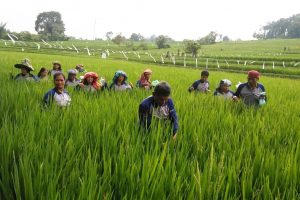
The existence of smallholder farmer (petani gurem) in Indonesia has a long and unique historical root. This paper intends to trace the traditional patterns of paddy-field ownership up to the 19th century based on Dutch East Indies Government sources. In short, it turns out that the gurem farmers own paddy field fields to produce rice not because of facilities from the government but because of their own effort, by clearing empty land, land that does not yet have an owner or the virgin forest. Kano (2008) expresses the term “yasa” or “yaso” for individual rice field owners who have been passed down from generation to generation in Java. “Yasa” or “yaso” in Javanese etymology means “everything that is obtained from individual efforts to turn wild land into cultivated land.” Furthermore, according to Kano, the term “yaso” or “yasa” in Javanese includes three meanings that occur at once, and are inseparable from each another, namely: working to open land, the fact of controlling or occupying land, and land rights. Therefore, by opening the land into rice fields, farmers control the land, occupy it, own it and cultivate it. In line with the term “yasa,” for the Priangan and Banten areas there is the term “milik,” which comes from Arabic (mel’k) which means recognition (diaku) of the ownership of the land.
The rights of the land for individuals or farmer families appear to have historical legitimacy, and indicate that the provision of food in Indonesia is directly or indirectly a burden of these small landowners. The results of a survey by the Dutch East Indies Government (1868-1869) show this fact. Referring to Kano (2008), this survey actually aims to reveal the traditional rights of indigenous peoples to land; guarantees held by natives to defend their rights of land; the factors that led to the release of their rights of land; as well as the rights recognized and deemed by the people to apply and use a free /empty land.
The survey was carried out in each residency in West Java, Central Java and East Java. For West Java the survey area covers the area of Banten, Jakarta, Karawang, Periangan and Cirebon. In Central Java, the survey area is divided into royal and non-royal areas. The non-royal territories include Tegal, Banyumas, Pekalongan, Bagelen, Semarang, Jepara and Kedu. Meanwhile, the kingdom area consists of Yogyakarta and Surakarta. The survey area in East Java consists of nine residencies, namely: Rembang, Madiun, Kediri, Surabaya, Pasuruan, Probolinggo, Besuki, Banyuwangi, and Madura.
The Pressure of Capitalist-Liberal in Parliament
The survey carried out by the Dutch East Indies Government was actually due to pressure from the capitalist-liberals in the Netherlands High Consultative Assembly. According to the description of Kano (2008), around the nineteenth century in the Netherlands the capitalist-liberals developed quite rapidly, where their business reached a very profitable level. The growing European market for various tropical agricultural & plantation products has prompted capitalists to pressure the Dutch East Indies Government to change the pattern of land tenure in Java, from a system of forced cultivation to a form of “colonization” (control) of land by private companies, namely private plantation entrepreneurs as the core managers of Java Island.
The demands of capitalist-liberals for land got a strong reaction from the “conservatives” who still wanted the forced cultivation system, in which the Dutch East Indies Government was the core ruler of the land, and continued to apply forced cultivation to local farmers in Java by planting various products that are considered beneficial for the Government. This has led to a fairly violent debate between the two interest groups, namely between the liberal-capitalists and the conservatives. The Liberals insist on two important things. First, the Dutch Government should have to recognize the absolute property rights (eigendom) of the native Indonesians over the lands they occupy so as to allow the lease and purchase of land by private Dutch companies. Second, the government had to determine that all lands which could not be proven that the right to land is an absolute property right of the individual community is the right of the state. Furthermore, the capitalist-liberals demanded that the Government provide opportunities for private companies to control the land in the form of cheap long-term leases (erfacht land).
The conservatives objected to the demands of the liberals for two main reasons as well. First, if the demands of the liberals are granted it will disturb domestic peace and security, so that the “conservatives” will vigorously challenge the desires of the liberals. Second, the land rights for natives have been based on indigenous, communal and local customary requirements, so it is impossible to regulate them on the basis of Western property rights.
Due to these two contradictory ideas, and to determine a satisfactory policy for both parties, the Dutch East Indies Government felt the need to conduct research to find out the original laws that traditionally applied to the people of the Netherlands Indies. Therefore, this research was officially announced by the Kingdom of the Netherlands and ordered to the Dutch East Indies Government.
The Rights of Paddy-Field Ownership
In line with the above debates, the survey focused on identifying the forms of land owned by the community, as well as forms of traditional ownership over these lands. Therefore, the survey report has presented various forms of land owned by the community in detail, consisting of rice fields, dry land, homestead land and gardens. In addition, this report also presents data on fish ponds, nifah forests, and salt fields. More importantly, for the purposes of the survey, this report presents the categories of ownership for each form of land owned, which is broken down into: (1) individual traditional ownership, (2) communal ownership, (3) legal use, and (4) special rights (Kano, 2008).
However, from the various types of land owned by indigenous peoples, it turns out that the most important land classification for traditional Javanese people to survive is rice fields, not dried land or other forms of land. The ownership of rice fields traditionally consists of two main categories, namely individual and communal ownership. From the 808 villages sampled in this study, almost all villages have rice fields. There are only 33 villages without rice fields, and there are 264 villages without dried land. This means that farmers can live without dried land, but cannot live without paddy-fields. This is related to the staple food of Indonesian society in general, or Java in particular, which has traditionally depended on rice.
The ownership of rice fields is dominated by hereditary individual ownership as well as communal ownership. From the 808 study locations, there are 452 villages that have rice fields based on personal ownership from generation to generation. Likewise, there are 480 villages whose rice field ownership pattern is communal. Individual and communal ownership forms are found in 178 sample villages (Kano, 2008).
The individual ownership of paddy fields, as has been briefly described, is the result of efforts made by individuals to use wild land or land that does not yet have an owner into productive rice fields. Referring to Kano’s description (2008), the names of these individual fields are closely related to the names of the makers. In the Banten region, for example, there are terms of yasa, yasa sorangan, and babedohan which describe individual efforts in making these paddy-fields. In the villages of the Priangan region (West Java) there are terms that are closely related to the efforts made by individuals, such as yasa, apaal, and alpukah which means the desire or creation made by someone in forming the rice field. In several other areas, there are various local terms that describe the same meaning. In Probolinggo, for example, there are origin terms such as: gawean debi, caluk debi, babadan, and bukaan which describe the efforts to clear land by a number of individuals.
Traditional Norms of Individual Paddy land Ownership
Referring to the same source, individual ownership of rice fields tends not to be absolute ownership. The concept of ownership in modern society (eigendom) cannot be applied to land ownership in traditional Javanese communities. This is often marked by communal constraints on absolute ownership of rice fields. In addition, there are often strict regulations that hinder the sale of rice fields, or even strictly prohibit the sale of rice fields. In this case, the Dutch East Indies Government survey also reported that the owner of rice fields (or in fact someone who is considered as the owner) is not based on official ownership evidence but on the basis of recognition from the entire village community; and this can only be done for individuals who are really working or really interested in working on the fields.
In line with this, there are traditional norms regarding land ownership and procedures for transferring ownership rights of paddy fields, either to other individuals or transferring ownership to communal property. In essence, the rights to rice fields can be applied from generation to generation, but this is only for individuals and their descendants who are able to carry out their obligations in managing the fields. If they are no longer able to take care of land, then the rice field becomes communal property. If the inheritor is still a child or immature girl, then the obligation to take care of the rice field can be carried out by another party on behalf of the owner’s family. If the heir is an adult or the girl is married, then the management of the rice fields can be handed back to the party entitled to the field.
In the passage of time, the paddy fields have passed from generation to generation. If it has been far from the creator, the rice field will become – or considered as – an inheritance. Kano (2008) mentions several terms of heirloom rice fields. In Banten, for example, there are terms of pusaka, yasa pusaka, turunan, tetilar, tetinggal, wasiat kolot, and warisan ki kolot. In the Priangan area, there are terms of pusaka, tetinggal, turunan, and waris. In Karawang, there are also the terms of turunan, tetinggal, waris and warisan. Likewise, in several areas that were the focus of the Dutch East Indies Government survey, such as Cirebon, Tegal, Banyumas, Pekalongan, Bagelen, Jepara, Rembang, Madiun, Kediri, Surabaya, Pasuruan, Probolinggo, and Besuki, there are the same or almost the same terms, which describes the existence of individual ownership of rice fields from generation to generation.
Regarding the transfer of ownership of paddy fields, there are regulations that complicate or even prohibit the transfer of rights to rice fields, especially to individuals who come from outside the village. Traditionally, paddy fields are not a commercial asset that can be bought and sold in general. In many villages in Central Java and in Pasuruan, East Java – which were recorded in a survey by the Dutch East Indies Government – there was a prohibition on transferring rice fields to parties from outside the village. The same norm – as written by Kano (2008) – occurs in Probolinggo, Besuki, and Banyuwangi which are in line with the provisions that tighten the obligation to manage rice fields. However, there is a difference with the trend in Priangan areas which are traditionally less strict for the transfer of ownership of rice fields to individuals from outside the village. For the traditional Priangan community, rice fields tend to be more commercial in nature.
The non-commercial land ownership patterns are in line with subsistence land cultivation patterns. In simple terms, subsistence means farming activities that are oriented merely to meet the needs of individuals and families, not profit-oriented and not market-oriented. According to Rahardjo (2017), the subsistence can be interpreted as a way of life that tends to be minimalist, in which the activities of working on agricultural land are aimed at just living. Warthorn (Rahardjo, 2017) distinguishes between subsistence production and subsistence life. The production subsistence is characterized by low degrees of commercialization and monetization; while the subsistence life is related to a minimalist life, which is just life. The subsistence agriculture indicates farming activities aimed merely to provide self and family needs, where all production is consumed and nothing is sold. In addition, there are no outside users or producers of goods or services entering their village.
One of the important characteristic of subsistence farmers in managing agricultural land, according to Scott (2019) based on his research in Southeast Asia, is a high dependence on the compassion of nature. This means that the technology used is very simple, so it is less able to control natural risks. However, from the various techniques used, the farmers try to choose routine techniques that minimize failure. Quoting Roumasett, Scott (2019) suggests the principle of subsistence which puts forward the concept of “safety first”, which becomes the basis for small farmers in managing their land. However, because farmers’ profit margins are very small, even with the best techniques according to farmers, they are still prone to crop failure.
The Communal Paddy Field Ownership
The hereditary land ownership rights of individual peasants, as described above, are legal social property rights, but have no real certainty. This means that the farmers do not fully own the rights to the land. Thus Scot (2019) emphasized based on his observations in Tonkin (Upper Burma) and in Java. The tug-of-war between the individual ownership and communal ownership appears very strong, as illustrated by the description above. The individual rice field ownership cannot be separated from communal ownership. The “violations” committed by individual rice field owners – such as failing to carry out their obligations in managing the rice fields – resulted in the transfer of ownership of the rice fields to communal property, in addition to the rice fields which had already become communal property. Referring to Kano (2008), the communal rice fields are institutionally managed by the village. Therefore, these communal rice fields are often referred to by various local terms, such as sawah desa, playangan, bumen-bumen, prutahan, lanyah, sawah sanggan, baku, bumi, kebumen, norowito, sewan, krajan, jung, bakon, kramanan, ideran, baratan, auman, bagen, kongsen, negoro, and rojo which illustrate the strong role of the community for the rice fields control.
The individuals can manage or work on communal rice fields with a number of requirements, one of which is that a cultivator must be willing and able to do compulsory work in managing the land. The cultivators must be married, they must also have a yard or house. In addition, and more importantly, is that the proposal of an individual to cultivate communal rice fields must be approved by the other cultivators. An important provision for communal rice cultivators is the prohibition of selling or transferring the management rights of the land to other parties. The management of the rice fields is carried out in rotation and periodically. However, Kano (2008) illustrates that these requirements are not a definite thing. In a number of villages, the requirements for marriage, owning a house and yard sometimes do not apply. What is clear is that the management of communal rice fields is very dependent on the agreement of the villagers.
The communal ownership is quite dominant in traditional Javanese society compared to individual ownership. From the 808 villages that were the object of the survey, 480 villages had rice fields in the form of communal ownership. The communal rice fields, which are shared rice fields, are also cultivated by individual farmers. The village head plays a very big role in distributing the rice fields to the cultivators. Referring to Kano (2008), the division of communal rice fields can be done through: (a) the village head determines the distribution of communal land for the tenants; (b) agreement is reached between the tenants who control part of the land; and (c) there is arable land for the village head or village officials in particular, especially if the village head does not have the “sawah bengkok” or the rice fields designated specifically for the village head or village officials. In the absence of “sawah bengkok” the village heads or village officials often received a larger share of the communal rice fields.
The communal land cultivators can be divided into two parts based on the amount of energy they provide, namely: tenant peasants with full employment obligations; and farmers with partial work obligations. In certain areas, there are different specific terms for the two groups of smallholders. The smallholders with full work obligations are often referred to as sikep kecapak, sikep patuh, kuli kenceng, and gogol kenceng. Meanwhile, working peasants whose work is not full are often referred to as cilik sikep, sikep kresak, wong kendo, gogol kendo, setengah kuli, kuli setengah kuat, and so on. Even though the cultivators have been going on for some time, the cultivators cannot pass it on to their children. This is different from rice fields owned by individuals that can be inherited. The practice of cultivating this land, referring to Scott (2019), undoubtedly creates a hierarchical relationship that creates social classes among subsistence farmers.
Regarding the area of rice fields cultivated, it depends on the number of cultivators. The greater the number of working farmers, the narrower the land area they cultivate. Many farmers cultivate rice fields with an area of half bau (0.35 ha) or a quarter of bau (0.17 ha). In a very extreme case, the area of arable land was only 0.09 ha, which occurred in Blotongan Village, Semarang; and an area of 0.07 ha in Bugel Village, Jepara.
The “Benhgkok” Paddy-Field and the Communal Paddy-Field
The discussion of communal land in the Java region cannot be separated from the existence of “bengkok” land. The latter is a term for sawah (paddy field) which is designated for officials, where they get part of the land for their office which can be used for their personal gain. The officials in this case are divided into two groups. First, it is the indigenous officials such as regents and wedana residing in the city. Second, it is the head of the village or village officials who live in the village. The first group was obliged to obtain rice fields from apanage land, namely land that was specifically allocated for these officials by the Dutch East Indies Government. These rice fields are often referred to as “lungguh di Nanggarung” and “bengkok di Mancanegara.” (Kano, 2008).
The second type of official who is a lowly official – namely the village head who lives in the village – obtains a rice field that is designated for the village head and the village official, comes from the “bengkok” rice field, namely the village’s rice field. If the village does not have “bengkok” paddy field, the “salaries” for the lurah and village officials are taken from the communal land. Strictly speaking, part of the communal land – in fact it is most of it – was earmarked for the “salary” of the village head and village officials. Kano (2008) with refer to a survey report by the Dutch East Indies Government states, of the 808 sample villages, there are 523 villages that have land positions for village heads and village officials. However, of the total number of villages, 469 villages have occupational rice fields derived from communal land; while the villages that have “bengkok” land are only 54 villages. For this reason, communal land in most villages is allocated for the “salary” of the village head and village officials, and only a small portion of the communal land is given to smallholders, with very narrow rice fields being handed over to smallholders.
Closing
Thus, the land in Java which is most important and is the basis for their livelihood is the paddy field, not the dry land or fish ponds. The rice fields are a symbol of social status for their owners. The size of rice fields owned is related to the high social status of the owner. In terms of ownership, the rice fields are divided into two parts, namely individual and communal rice fields. The individual rice fields are made by individual creativity, and it seems that these individual rice fields need to be the focus of discussion in looking at the continuity of agricultural land in the modern era. The communal rice fields were partially devoted in history to village heads and village officials, and a small portion was left to individual smallholders, either full-time or part-time cultivators. The “bengkok” rice fields, which are the rice fields designated for village heads and village officials, are not large in number compared to communal rice fields.***
Reference
Kano, Hiroyoshi (2008), “Sistem Pemilikan Tanah dan Masyarakat Desa di Jawa pada Abad XIX,” [“The System of Land Ownership and Village Communities in Java in the XIX Century],”in SMP Tjondronegoro and Gunawan Wiradi (editor), Dua Abad Penguasaan Tanah: Pola Penguasaan Tanah Pertanian di Jawa dari Masa ke Masa [Two Ages of Land Tenure: The Pattern of Agricultural Land Control in Java from Time to Time]. Jakarta: Yayasan Obor Indonesia;
Rahardjo (2017), Pengantar Sosiologi Pedesaan dan Pertanian [Introduction to Rural and Agricultural Sociology] Yogyakarta: Gadjah Mada University Press.
Scott, James C. (2019), Moral Ekonomi Petani: Pergolakan dan Subsistensi di Asia Tenggara [Moral Economy of Peasant: Upheaval and Subsistence in Southeast Asia], Jakarta: LP3ES.